Habit Buddi
Habit Buddi had me acting on the other end of my degree, fully on 'Interaction Design' at Cal State East Bay as part of the Spring 2025 Semester collaborating with my peers, Mishelle Taborga and Hanh "Mia" Dang on putting together a design document for a hypothetical smartwatch application. Our objective was to put together all the work and documentation one would need to pitch a product, alongside bonuses for creating an actual prototype of some sort for your UI/UX.
Within this project, Mia and Mishelle handled final artistic assets and our presentation, while I was the primary one responsible for compiling a wireframe flow, paper prototype, and guiding some playtests to ensure it was comfortable to use.
Design Process
To begin, we each brainstormed what we actually cared about, what we would even build a smartwatch application for. We needed to actually justify the form factor, and ultimately realized we all have, or currently struggle with nasty habits. By designing our app to counteract bad habits, staying ever present without being on your phone a source of many negative behaviors, proved the direction we all could believe in. For the purposes of our project as a pitched idea, we focused our case studies and user personas around generally drug related habits, as each of us knew someone who had directly struggled with something like alcoholism, marijuana, or tabacco products. We reflected on how they overcame those habits and also researched methods online for breaking bad habits. Additionally, we conducted literature reviews on general strategies for overcoming habits and the common barriers people face in the process.
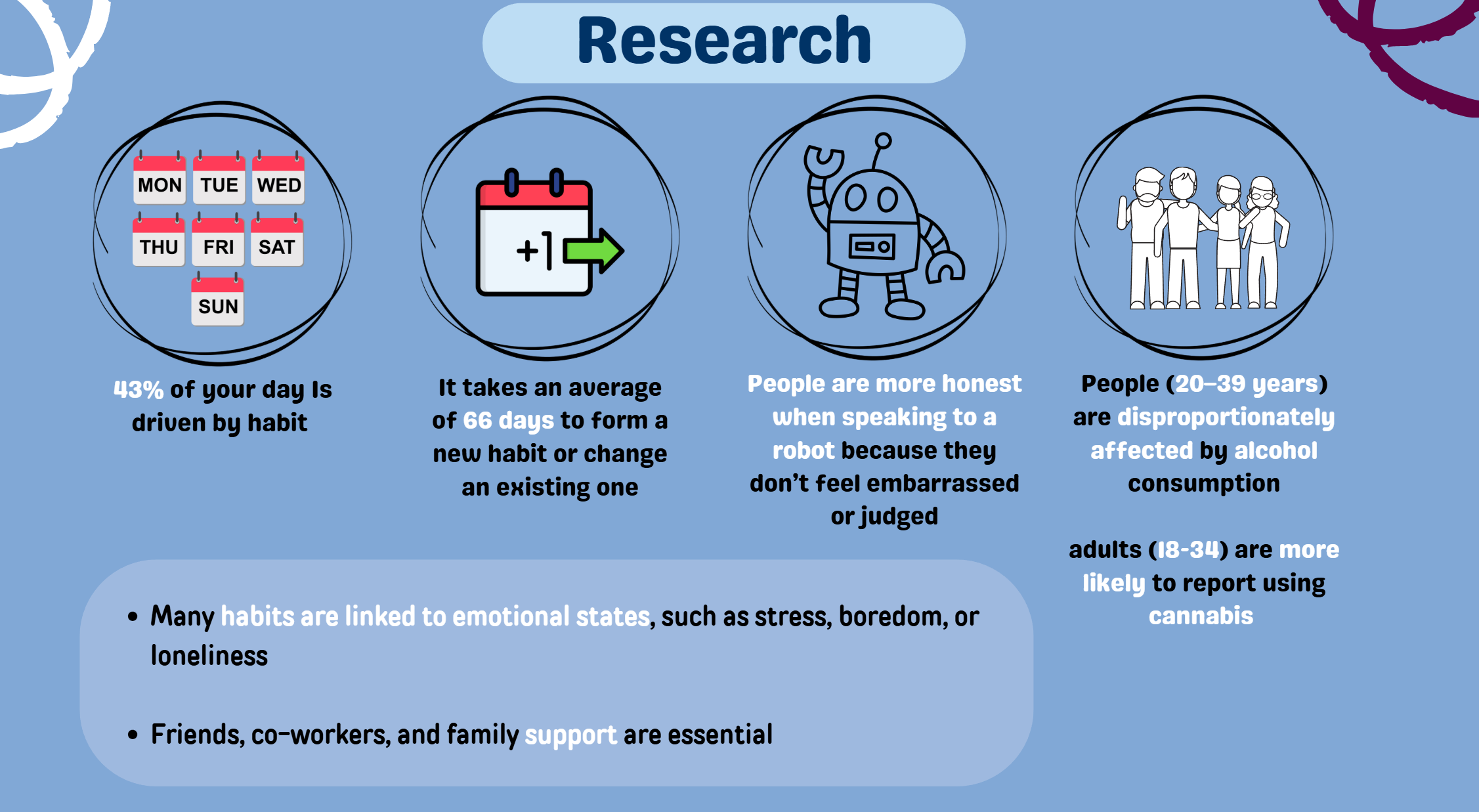
Slide representing some research findings
Once we get past brainstorming, my process became a long cycle of compiling flowcharts and an overall framework of how the application would actually work. One of my fondest pieces of advice from Professor Ian Pollock in this course, was to always bear in mind how users inherently cover up half the screen with their fingers. In moments, it snapped to me why minimizing text in favor of recognizable icons was so essential, and contributed to our teams idea to integrate an on board 'AI Assistant' to vocalize and help track schedules. Reading was the enemy for the final application that we wanted to be easy and simple to navigate, and it came time to put design to form.
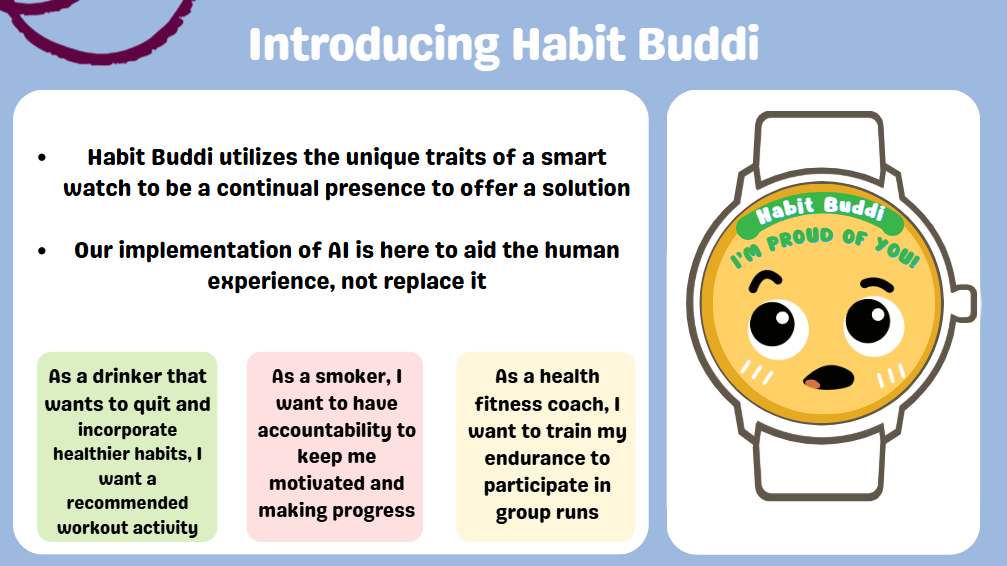
Final showcase slide used in class presentation

Example of a wireframe flow I put together for this project
At the end of our design process, Mishelle Taborga, Hanh "Mia" Dang, and I settled on an AI Companion for a critical reason. We understand to a certain degree, it plays with fire to put a chatbot in an emotionally charged role, so we opted for a lifestyle coach. One thing that was understood across us, and in our findings was that the presence of a peer, support is essential to overcoming our worst aspects. Thus, Habit Buddi binds all of its features within a chatbot, guiding users from features involving help with map navigation, keeping track of goals, offering gamified elements such as additional designs for their 'Buddi'. At the end of the day though, the goal we held was first and foremost to cultivate a friendly design for self-improvement, and operating upon our research we know we hit our marks.
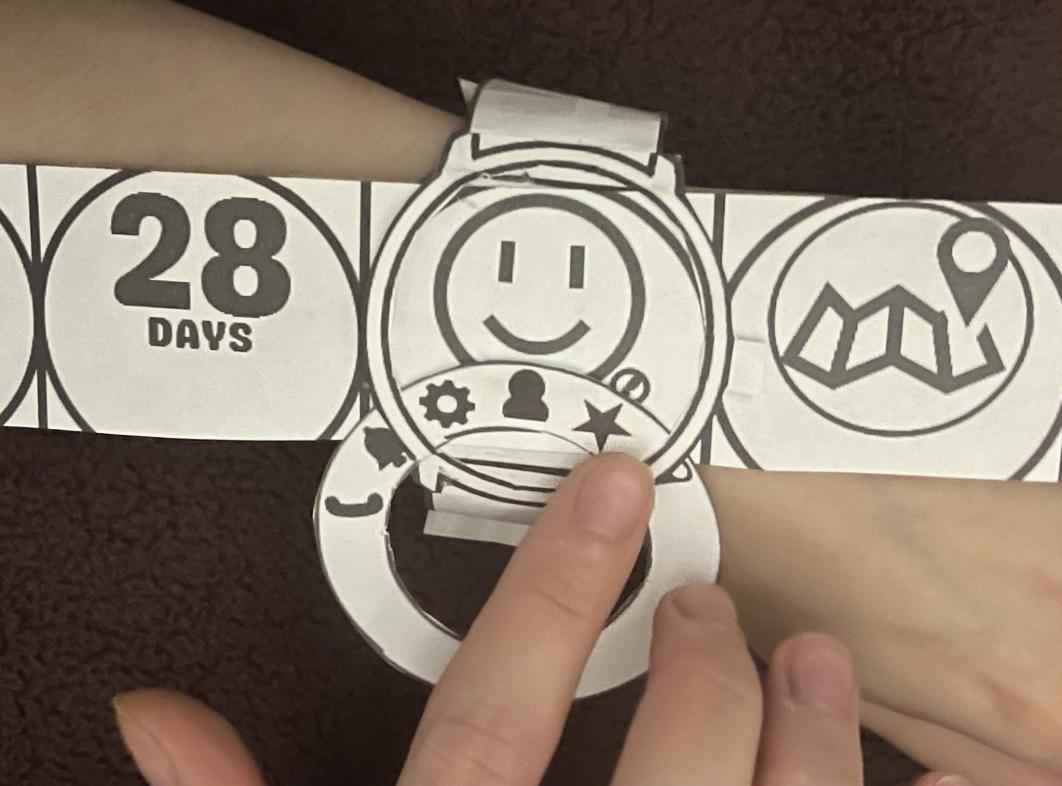
A fun but time consuming paper prototype I made for testing
Through this effort, Habit Buddi gave me a lot of skills in adaptation. To be entirely frank, I hated the initial premise of the assignment when first given it in class. I had not even used a smartwatch, let alone consider how to design directly for it. Yet, in confronting that, I found much more joy working with my team and creating an idea within those limitations regardless. While pressing at times to keep work, ultimately I feel we stole the show during presentations, with it giving me much more confidence in tackling projects with major creative difference.